
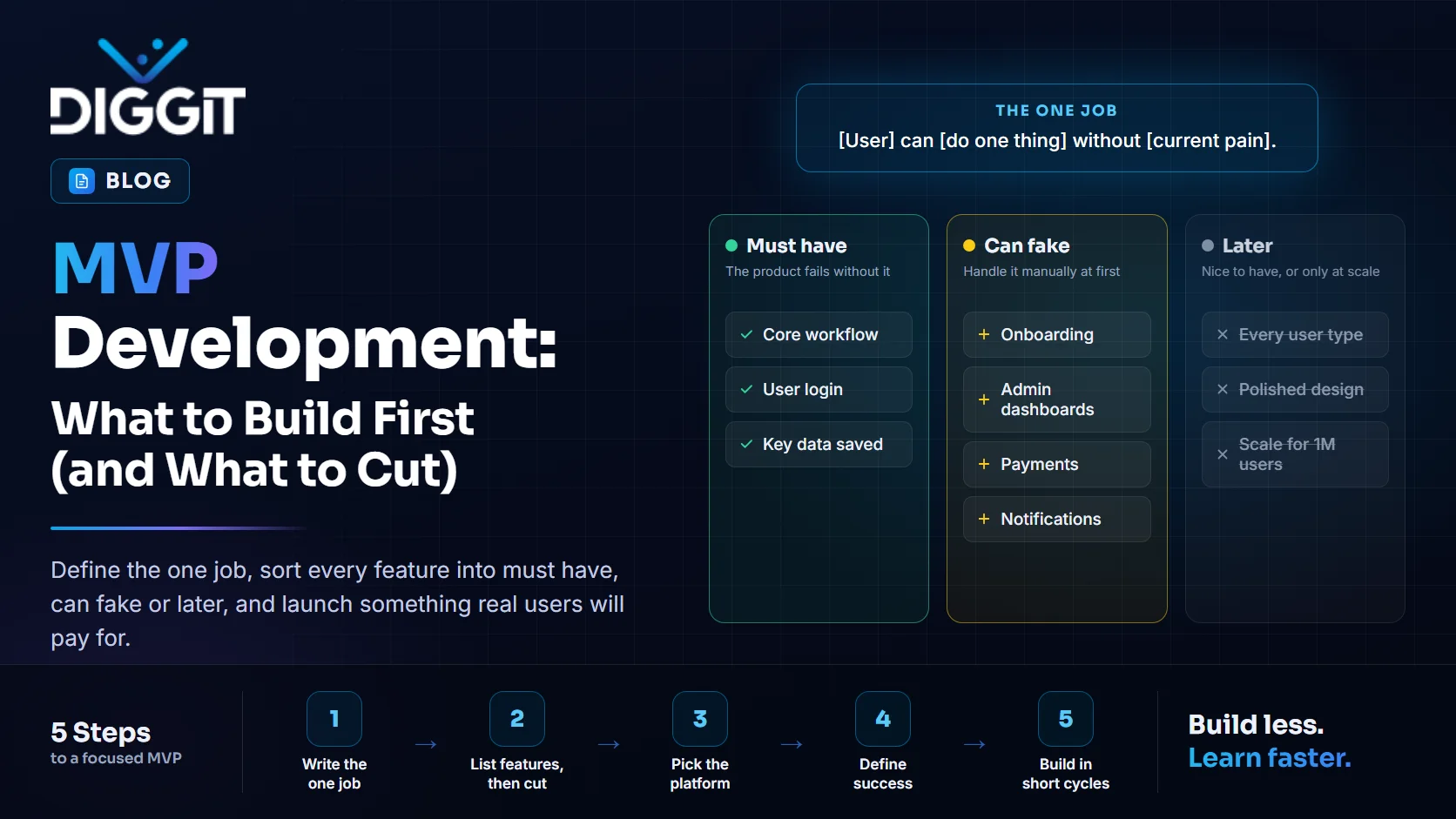
MVP development means building the smallest working version of a product that real users will use and pay for, so you can learn what they actually need before spending on everything else. A good MVP does one job well for one type of user. The hard part isn't building it. It's deciding what to leave out.
Most MVPs go over budget for the same reason: they stop being minimal.
What an MVP is, and what it isn't
| An MVP is | An MVP isn't |
|---|---|
| A working product real users can use | A clickable mockup or slide deck |
| Focused on one core job | A smaller version of every feature you've planned |
| Built to test whether people will use and pay for it | Built to impress investors with polish |
| Expected to change after launch | The final architecture |
A prototype tests whether an idea makes sense. An MVP tests whether people will use it and pay for it.
Step 1: Write down the one job
Finish this sentence: "[User] can [do one thing] without [current pain]."
For example: "A small sales team can send a quote and see when it's been paid, without chasing spreadsheets." If you need more than one sentence, your MVP is too big.
Step 2: List every feature, then cut
Write down every feature you've imagined. Then sort each one into three columns:
| Must have | Can fake for now | Later |
|---|---|---|
| The product doesn't do its one job without it | Needed, but can be handled manually at first | Nice to have, or only matters at scale |
Can fake for now is where most savings are. Examples:
- Onboarding: set up early customers yourself instead of building self-serve signup flows
- Admin dashboards: pull reports straight from the database for the first months
- Payments: send invoices manually before building in-app billing
- Notifications: send emails by hand until you know which ones matter
Step 3: Pick the platform users actually work on
Build for where your users are. If they're at a desk, start with a web app. If they're on their feet, in a workshop or out in the field, start with mobile or tablet. Building both at once roughly doubles the work. Our guide to web app vs mobile app covers how to choose.
Step 4: Decide what "it worked" means before you build
Pick two or three things you'll measure after launch, such as:
- How many people sign up and complete the core job
- How many come back in week two
- How many pay, or say they would at your price
Without these, you'll launch and not know whether to keep going.
Step 5: Build in short cycles with a working product each time
Agree on a plan where something usable is delivered every two weeks or so, not one big reveal at the end. You'll spot wrong assumptions early, while they're cheap to fix.
How much does MVP development cost?
It depends on the team's size, its rates and how many weeks the build takes. A tightly scoped MVP built by a small team costs far less than a feature-heavy version 1. Our guide to custom software development cost shows how to estimate it from team size, rate and duration.
On contracts: MVPs usually change during the build, so a short fixed-price scoping phase followed by capped time and materials often works better than one fixed price. We explain why in fixed price vs time and materials.
Five mistakes that turn an MVP into a full product
- Adding "just one more" feature before launch. Every addition delays the moment you learn something.
- Building for every type of user. Pick one. Add the others once the first is happy.
- Polishing the design before testing the idea. Clean and clear is enough. Beautiful can wait.
- Building scale you don't need. A setup for a million users isn't needed for your first hundred. Plan for growth, but don't pay for it yet.
- No plan for after launch. Budget time and money for changes based on what you learn. That's the point of an MVP.
What to look for in an MVP development partner
- They push back on your feature list instead of quoting everything
- They ask how you'll measure success
- They deliver working software every few weeks
- You own the code, designs and accounts from day one
- They've built and launched products of their own, not only client work
How Diggit builds MVPs
Diggit builds custom software for clients from our US company in Dallas, with our engineering team in Karachi. We also build and run our own products, including the Kordic CRM and the Revvio workshop app, so we've had to make the same "what goes in version 1" decisions ourselves.
Book a scoping call. Bring your one-sentence job and your feature list, and we'll help you sort the three columns.
Related questions
It depends on scope. A tightly focused MVP is usually measured in weeks to a few months. Each extra feature or user type adds time.
A prototype shows how something might work, often without real data or code behind it. An MVP is a working product that real users can use.
Sometimes. No-code tools can be a fast way to test demand. If the product needs custom logic, integrations or scale soon after launch, a coded MVP may save a rebuild later.
About the author: Montazir Abidy is co-founder of Diggit Software Solutions, which builds custom software for clients and runs its own products, including Kordic, GACS and Revvio. He leads business development and product strategy.