
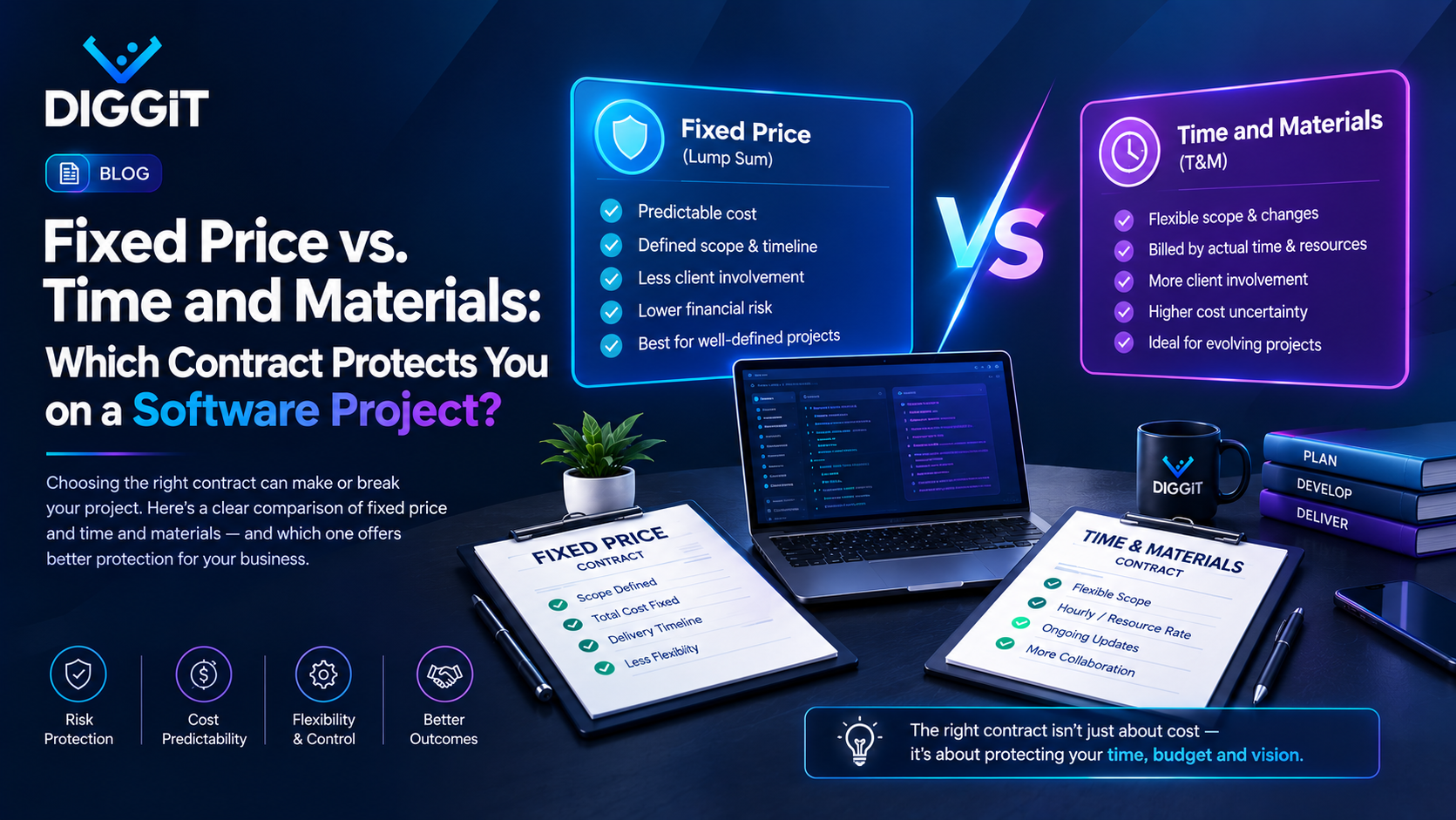
A fixed price contract sets one total cost for an agreed scope. A time and materials (T&M) contract bills for the hours actually worked at agreed rates. Fixed price protects your budget only when the scope is clear and won't change. T&M protects your ability to change course, but only if you can see the hours as they're spent. For most custom software, the safest option is a mix: a short fixed-price discovery phase, then T&M with a ceiling.
The choice changes who carries the risk, not whether there is risk.
How each model works
Fixed price. You and the vendor agree on exactly what will be built and what it will cost. If the work takes longer than the vendor estimated, the vendor absorbs the cost. If you want something that wasn't in the agreed scope, you pay for a change request.
Time and materials. You agree hourly or daily rates for each role. You pay for the time worked, plus any direct costs like software licenses. If the work takes longer, you pay more. If you want to change direction, you can, without renegotiating the contract.
The US government's own rules draw the same line. The Federal Acquisition Regulation says a T&M contract may be used only when it isn't possible to estimate the extent or duration of the work with reasonable confidence, and it requires a ceiling price the contractor exceeds at its own risk. That's a useful rule for private buyers too.
Fixed price vs. time and materials at a glance
| Fixed price | Time and materials | |
|---|---|---|
| Budget certainty | High, if scope holds | Lower, depends on hours |
| Flexibility to change | Low, changes cost extra | High |
| Who carries overrun risk | Vendor | You |
| Price includes a risk buffer | Usually | No |
| Best when | Scope is small and fully defined | Scope will evolve as you learn |
| Main danger | Paying for change requests, or a vendor cutting corners to protect margin | Hours drifting with no one watching |
When fixed price works
Fixed price is a good fit when:
- The project is small, like a marketing site or a single integration
- You can describe every screen and rule before work starts
- You've built something similar before, so there are few unknowns
- The deadline and budget matter more than the ability to change your mind
When fixed price backfires
Vendors know estimates are uncertain, so a fixed price usually includes a buffer for risk. You pay that buffer even if nothing goes wrong.
The bigger problem is change. Most software projects learn something in the first few weeks that changes the plan: a user needs a feature nobody thought of, or an integration turns out harder than expected. On a fixed contract, each change becomes a negotiation. Either you pay for change requests, or the change gets left out.
There's also a quieter risk. When a fixed-price project runs over, the vendor is losing money on every extra hour. That creates pressure to cut testing, documentation or code quality to finish.
When time and materials works
T&M fits when:
- You're building a new product and expect to learn as you go
- Requirements depend on user feedback you don't have yet
- The work is ongoing, like adding features to a live product
- You or someone on your side can review progress every week
When time and materials backfires
T&M fails when nobody watches it. Without weekly visibility into hours, progress and what's left, costs drift. The vendor has no built-in reason to be efficient, which is exactly why the FAR requires a ceiling price and government oversight on these contracts.
The model most software buyers should use
Most custom software projects do best with a mix:
- Fixed-price discovery. Pay a fixed fee for a short phase that produces a detailed scope: user types, screens, integrations and an estimate. You own the output, whether or not you continue with that vendor.
- Time and materials with a cap. Build on T&M, with a ceiling per phase or per month. The vendor can't exceed it without your written approval.
- Weekly reporting. Hours spent, work finished and work remaining, every week. If a vendor can't provide this, don't sign a T&M contract with them.
This gives you most of the budget control of fixed price and most of the flexibility of T&M.
Questions to ask any vendor before you sign
- What's included in the price, and what counts as a change?
- How is a change priced, and who approves it?
- What's the ceiling, and what happens when we get close to it?
- What will you report each week?
- Who owns the code and designs if we stop partway through?
How we work
Diggit builds custom software for clients from our US company in Dallas, with our engineering team in Karachi. We also build and run our own software products, so we plan projects the way we'd want our own planned.
If you're weighing a project, our guide to custom software development cost explains what drives the price. When you're ready, book a scoping call and we'll help you pick the right contract for your project.
Related questions
Not necessarily. Fixed prices usually include a buffer for the vendor's risk. On a well-run T&M project, you pay only for work actually done.
A T&M contract with a ceiling price. You pay for hours worked, but the vendor can't bill past the ceiling without your approval.
Yes, if both sides agree to amend the contract. It's common after a fixed-price discovery phase.