
Quick answer
Building an AI agent in 2026 costs $5,000 to $300,000+ in the US. A small business automating one workflow (lead follow-up, appointment booking, support FAQs) typically spends $5,000–$25,000 to build and $100–$800 a month to run. Agents that connect to several systems, take actions on their own, or handle regulated data cost $40,000 and up.
Most pricing guides are written for enterprises with six-figure budgets. This one is written for US small and mid-sized businesses. You will see what each type of agent costs, what you pay every month after launch, and how to start without overspending.
We build AI agents and automations for US businesses at DIGGIT Global, so the numbers below reflect what these projects actually involve, checked against current US market rates.
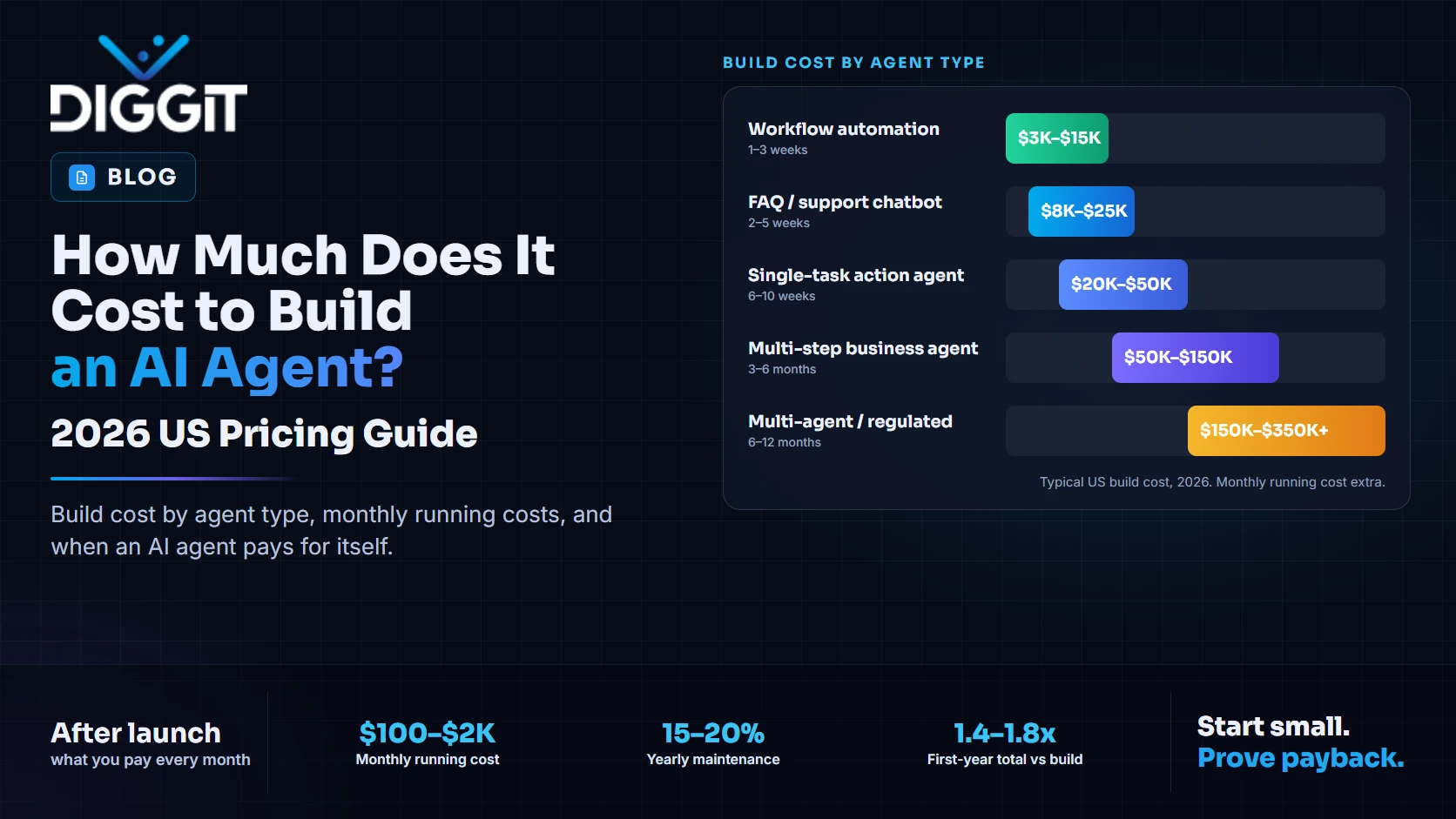
AI agent cost by type (2026 US pricing)
The biggest factor in price is how much the agent does on its own. An agent that answers questions costs far less than one that updates your CRM, sends emails, and books meetings without a human checking.
| Agent type | What it does | Build cost | Timeline | Monthly running cost |
|---|---|---|---|---|
| Workflow automation agent | Runs one repeatable process with an AI step, built on n8n, Make, or Zapier (lead routing, email triage, invoice extraction) | $3,000–$15,000 | 1–3 weeks | $50–$300 |
| FAQ / support chatbot | Answers customer questions from your website, docs, and policies (RAG) | $8,000–$25,000 | 2–5 weeks | $150–$800 |
| Single-task action agent | Takes actions in 1–2 tools: books appointments, qualifies leads, updates the CRM | $20,000–$50,000 | 6–10 weeks | $500–$2,000 |
| Multi-step business agent | Plans and completes tasks across 3–5 systems with approvals and handoff to staff | $50,000–$150,000 | 3–6 months | $1,500–$6,000 |
| Multi-agent or regulated system | Several agents working together; HIPAA, SOC 2, or financial compliance | $150,000–$350,000+ | 6–12 months | $5,000–$15,000+ |
Ranges reflect published 2026 pricing from US and European AI development firms, including Master of Code and Radixweb.
The first row is the one most guides leave out. Many small businesses don't need a fully custom agent. A well-built automation with one AI step often delivers most of the value at a fraction of the price, and it can grow into a custom agent later.
What drives the cost of an AI agent
Six things decide where your project lands in the table above. If you understand these, you can read any quote and see where the money is going.
- Autonomy. An agent that only reads and suggests is cheap. One that acts on its own needs guardrails, approval steps, rollback logic, and much more testing. Each step up in autonomy adds cost to the build and to every task it runs.
- Integrations. Every system the agent connects to (CRM, calendar, ERP, email, payment tools) adds work. A modern tool with a clean API might add $2,000–$8,000. An old system with no API can add $15,000 or more. Write access costs more than read access because every action needs checks.
- Your data. If the agent answers from your documents, someone has to clean, organize, and keep that content up to date. Messy data is the most common reason projects run over budget. Gartner expects 60% of AI projects without AI-ready data to be abandoned through 2026.
- Testing and guardrails. A demo can be built in days. A production agent needs test cases, checks for wrong answers, and protection against misuse. Budget about 10–15% of the build for this. Cheap quotes often leave it out.
- Single agent vs. multiple agents. Systems where several agents hand work to each other cost roughly 1.5–2x more to build. They also use far more AI tokens: Anthropic's engineering team measured multi-agent systems using about 15x the tokens of a normal chat.
- Compliance. Healthcare (HIPAA), finance, and anything handling sensitive personal data needs extra security work, audit logs, and often private hosting. These builds rarely come in under $150,000.
Team location matters too. A US-based team charges $150–$250 an hour, while experienced offshore teams deliver the same scope for a fraction of that. That is a big part of why two quotes for the same agent can differ by 3x.
Monthly costs after launch
The build is only the first bill. Plan for four running costs, plus yearly maintenance.
| Cost item | Typical small business range | What it covers |
|---|---|---|
| AI model usage (tokens) | $20–$2,000/month | Every question or task the agent handles calls an AI model like Claude, GPT, or Gemini |
| Hosting and automation platform | $20–$500/month | Server, n8n or Make subscription, database |
| Knowledge base storage (vector database) | $0–$200/month | Only if the agent answers from your documents |
| Monitoring | $0–$200/month | Logs and alerts so you see errors and runaway costs |
| Maintenance and updates | 15–20% of the build cost per year | Prompt updates, model changes, fixing broken integrations, adding content |
Model choice has the biggest effect on monthly cost. As of October 2026, small fast models like Claude Haiku 5.5 cost about $0.10 per million input tokens, while flagship models cost $2–$10 per million (source). A well-built agent sends simple steps to cheap models and saves the expensive ones for hard reasoning. Since flagship output can cost 8x to 100x more than a small model from the same vendor, this one design choice often cuts the monthly bill sharply.
A useful rule: your first-year total is usually 1.4x to 1.8x the build cost once running costs and maintenance are added (Radixweb). A $20,000 agent should be budgeted as roughly $28,000–$36,000 for year one.
Example: what an AI lead agent costs for a small business
To make the numbers concrete, here is a typical small business scenario. The business is illustrative; the prices are GACS's published plan prices.
The business: A 12-person HVAC and plumbing company in the US that gets 250–300 leads a month from its website, Google Business Profile, and ads.
The problem: Leads that came in after hours or during busy jobs waited 3–5 hours for a reply. By then, many had already booked a competitor.
What gets used: GACS, DIGGIT's AI agent, on the company's website chat and WhatsApp. It is trained on the company's own website and service PDFs, so it answers from their real services, service areas, and policies. For every new lead, it asks 4 qualifying questions (service type, address, urgency, preferred time), sends the qualified lead to the CRM, and hands the conversation to the dispatcher with the full transcript to confirm a time. Emergencies go straight to a human.
| Item | Cost |
|---|---|
| One-time setup (channels and knowledge base connected on a call) | $299 |
| GACS Starter plan: 500 chats/month, website chat and WhatsApp, human handover, leads sent to Kordic CRM | $149/month ($1,490/year if paid yearly) |
| Extra chats above 500 | $0.25 each |
| WhatsApp marketing template messages, if used | Meta's fee + 10% |
Prices from the GACS pricing page, November 2026. If the company also wants the AI to answer phone calls, the Growth plan adds 200 AI call minutes for $399/month.
What it pays back: If faster replies win just 6 extra jobs a month at $350 average gross profit, that is $2,100 a month. Against a $149 plan and a $299 setup, the agent pays for itself in the first month.
Compare that with a fully custom build. The same lead agent built from scratch would cost roughly $14,000–$15,000 upfront plus about $300 a month to run. A ready-made platform makes sense when your use case is customer questions and lead qualification. A custom build makes sense when you need the agent to take actions a platform can't, such as booking directly into your scheduling software or changing orders.
Build in-house, hire an agency, or buy a ready-made tool?
For most small businesses, an agency build or a ready-made tool is cheaper than hiring an in-house AI team. Here is how the three options compare.
| Option | Upfront cost | Ongoing cost | Time to launch | Best for |
|---|---|---|---|---|
| Ready-made AI tool (SaaS) | $0–$500 setup | $50–$2,000+/month, often priced per conversation or resolution | Days | Common use cases where the tool covers about 80% of what you need |
| Agency or development partner | $5,000–$150,000 depending on scope | Running costs plus a maintenance plan | 2 weeks to 4 months | Custom workflows, your own data, and integrations with your existing tools |
| In-house AI team | $150,000+ a year per engineer | Salaries plus infrastructure | 6–12 months | Companies where the agent is the core product |
The in-house figure is not an exaggeration. The US Bureau of Labor Statistics lists a median salary of $140,300 for computer and information research scientists, before benefits and recruiting costs.
Ready-made tools are the cheapest start, but costs grow with volume. For example, Intercom Fin charges $0.99 per resolved conversation. At 3,000 resolutions a month, that is about $3,000 a month, every month. A custom agent at that volume often pays back its build cost within a year.
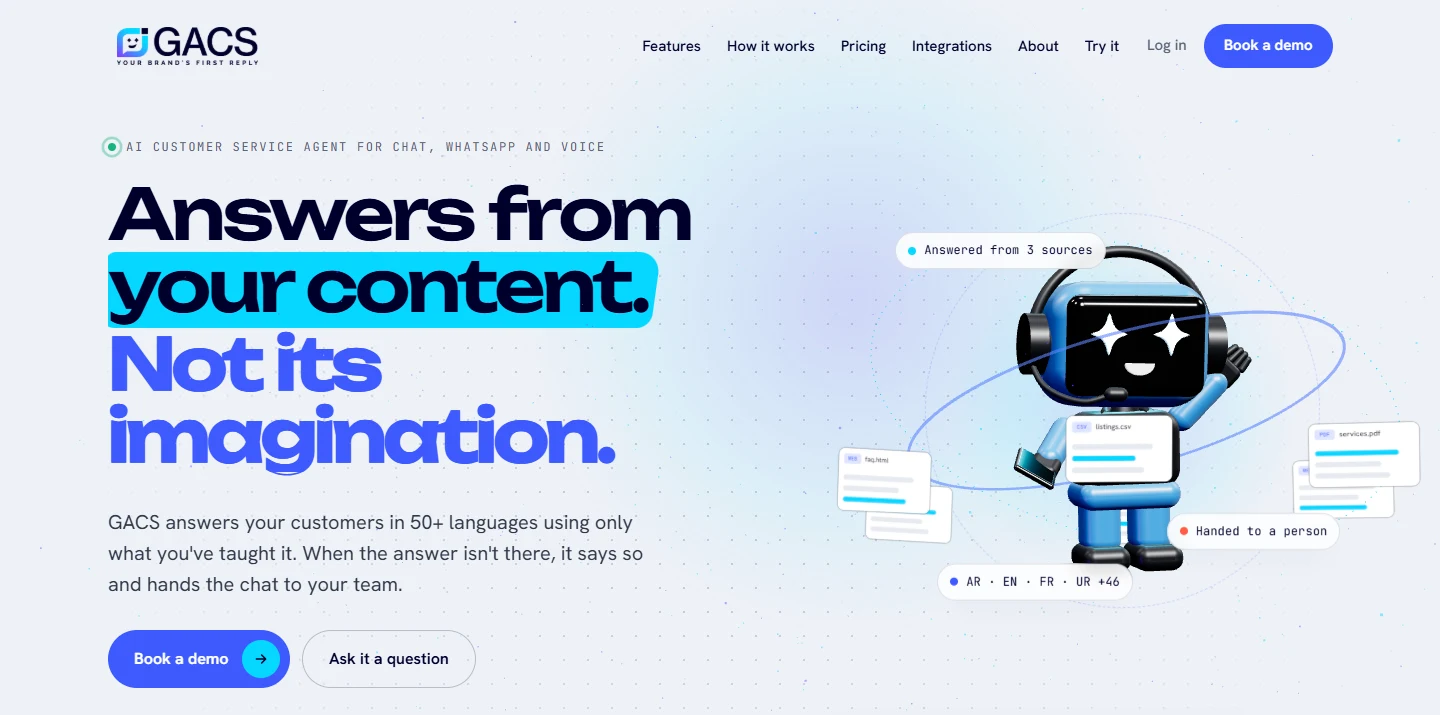
There is also a middle path: a ready-made agent that is set up on your own data. That is how we built GACS, DIGGIT's AI agent. It answers customers and qualifies leads on website chat, WhatsApp, and phone, and hands conversations to a human with the full transcript. Plans start at $149 a month for 500 chats, priced on chats and call minutes rather than per seat (pricing). Every plan starts with a free 20-minute demo on your own website content, so you see it answer real customer questions before you commit.
How to keep the cost down
The cheapest AI agent is the one that solves one painful problem well. These steps keep your first project small and safe.
- Start with one high-volume task. Pick something your team does dozens of times a week, like answering the same five questions or qualifying new leads. Don't start with "automate the whole business."
- Begin with an automation, not a full agent. A workflow on n8n or Make with one AI step often handles 70–80% of the job. Upgrade to a custom agent only when you hit its limits.
- Use existing AI models. Fine-tuning or training your own model is rarely needed for small business use cases. Good prompts plus your own documents usually get you there.
- Keep a human in the loop at first. Let the agent draft and a person approve. This cuts testing cost and builds trust before you give it more freedom.
- Connect only the systems you need for launch. Add more integrations after the first version proves its value.
- Set a spending cap. Limit how many steps the agent can take per task, and set alerts on AI usage, so a bug can't run up your bill overnight.
- Ask every vendor the same questions. Is the quote for a demo or a production system? Which integrations are included? Is testing included? What will it cost per month to run at our volume?
That last point matters. Gartner predicts more than 40% of agentic AI projects will be canceled by the end of 2027, mostly because of rising costs and unclear value. A clear scope and a small first step are the best protection.
When does an AI agent pay for itself?
An AI agent pays for itself when the staff time it saves each month is worth more than its running cost. Use this formula to check before you spend anything:
Payback (months) = Build cost ÷ (Monthly hours saved × Hourly staff cost − Monthly running cost)
Worked example. A support agent costs $15,000 to build and $400 a month to run. It handles 600 customer questions a month that each took a staff member about 6 minutes. That is 60 hours saved a month.
The US median wage for customer service representatives is $21.53 an hour. With benefits and overhead (about 1.3x), that is roughly $28 an hour, so the agent saves about $1,680 a month. After the $400 running cost, you net about $1,280 a month. The build pays back in about 12 months, and everything after that is savings.
The math gets better fast with volume. At 1,500 questions a month, the same agent pays back in about 4 months. If your task volume is low, a cheaper automation is usually the smarter first step.
Frequently asked questions
The cheapest way is a workflow automation with an AI step, built on a platform like n8n, Make, or Zapier. It typically costs $3,000–$15,000 to build with an agency and $50–$300 a month to run. It works well for single, repeatable tasks like routing leads or sorting emails.
A custom AI chatbot that answers questions from your website and documents usually costs $8,000–$25,000 to build and $150–$800 a month to run. Ready-made platforms cost far less to start. For example, GACS starts at $149 a month for 500 chats plus a one-time $299 setup, with no per-seat fees. Choose custom only when you need features a platform doesn't offer.
A simple automation takes 1–3 weeks. A support chatbot takes 2–5 weeks. An agent that takes actions across several business tools takes 2–6 months, mostly because of integration and testing work.
Most small business agents cost $100–$2,000 a month to run. That covers AI model usage, hosting, and monitoring. On top of that, budget 15–20% of the build cost each year for maintenance and updates.
Buying is cheaper at low volume and for common tasks. Building is usually cheaper long term when the agent handles high volume, needs your own data, or must connect to your existing systems. Compare the yearly cost of a per-conversation tool against a one-time build plus running costs.
Almost never. Small business agents use existing models like Claude, GPT, or Gemini, connected to your own data. Training a custom model adds tens of thousands of dollars and is only worth it in specialized cases.
Get a real number for your project
An AI agent's real cost is build plus run plus maintenance. For most US small businesses, the smart path is to start with one high-volume task, prove it pays back, then expand.
At DIGGIT Global, we build AI automations and custom agents for US businesses, from simple n8n workflows to CRM-connected agents built on Kordic. If you want a ready-made option instead of a custom build, our own product GACS is an AI customer service and sales agent for website chat, WhatsApp, voice, and email that qualifies leads and hands off to your team. Every quote shows the build cost, monthly running cost, and expected payback, so you know the full picture before you commit.
Tell us the task you want to automate, and we'll tell you what it will cost to build and run. Book a free AI automation consultation →