
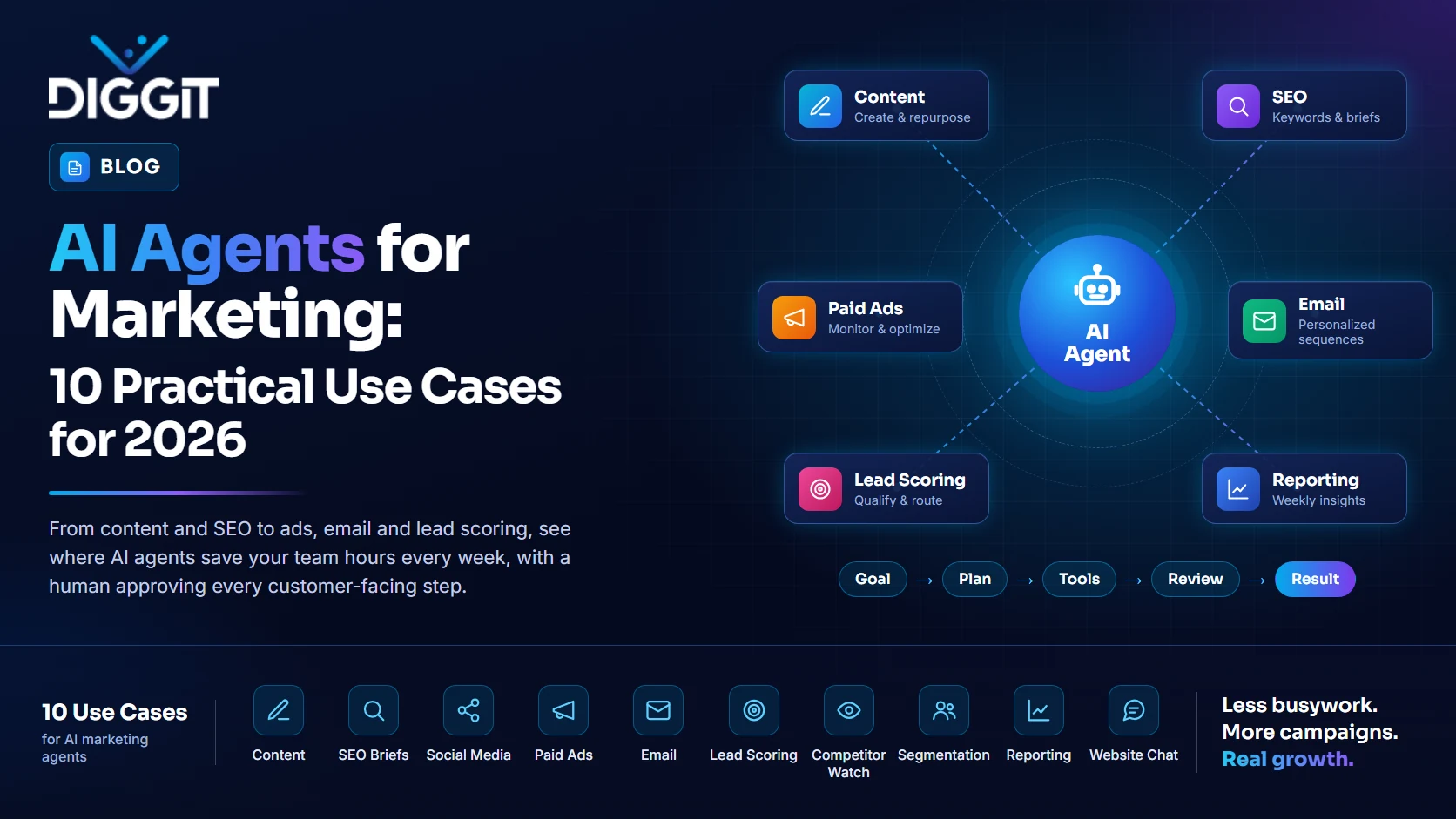
Quick answer: AI agents for marketing are AI systems that take a goal, plan the steps, use your tools (CRM, ad platforms, email, analytics), and complete marketing tasks with little human input. The most practical use cases today are content creation, SEO research, ad monitoring, email personalization, lead scoring, and reporting, with a human approving anything customer-facing.
What Are AI Agents in Marketing?
A regular AI tool answers a prompt. An AI agent works toward a goal. Give it a task like "find this week's underperforming ads and suggest fixes," and it pulls the data, analyzes it, drafts recommendations, and sends them for review.
That shift matters for marketing teams. McKinsey estimates that about 75% of generative AI's potential value is concentrated in four business functions: customer operations, marketing and sales, software engineering, and R&D.
- GoalYou set the outcome you want
- PlanThe agent breaks it into steps
- ToolsIt uses your CRM, ads, email, analytics
- ReviewA human approves anything customer-facing
- ResultTask done, results feed the next run
AI Agents vs Marketing Automation
Traditional marketing automation follows fixed rules: if a lead downloads an ebook, send email #2. AI agents decide what to do next based on context. Automation runs a workflow, while an agent can adapt the workflow. Most teams get the best results by combining both: rules for predictable steps, agents for steps that need judgment.
10 Practical Use Cases for AI Agents in Marketing
1. Content Creation and Repurposing
An agent turns one blog post into LinkedIn posts, email copy, and short video scripts that follow your brand voice guidelines.
Example: A webinar recording becomes a recap blog, five social posts, and a newsletter section, ready for editor review the same day.
2. SEO Keyword Research and Content Briefs
Agents pull keyword data, analyze top-ranking pages, and draft content briefs with headings, questions to answer, and internal link suggestions.
Example: The agent flags 10 low-difficulty keywords your competitors rank for and drafts a brief for each one.
3. Social Media Scheduling and Engagement
Agents plan a content calendar, schedule posts, and draft replies to common comments, escalating anything sensitive to a human.
4. Paid Ads Monitoring and Budget Optimization
Ad platforms already use AI heavily. Google AI powers Performance Max to maximize campaign performance across Google's channels. An agent adds a layer on top: it watches spend daily, flags campaigns drifting from your ROAS target, and drafts budget shifts for approval.
5. Email Personalization and Sequences
Agents segment your list, write personalized variants for each segment, and adjust send timing based on engagement.
Example: Customers who browsed pricing but didn't buy get a tailored follow-up instead of the generic newsletter.
6. Lead Qualification and Scoring
AI lead generation software scores inbound leads using form data, website behavior, and company details, then routes hot leads to sales instantly. Paired with CRM marketing automation, no lead sits untouched in an inbox.
7. Competitor and Market Monitoring
Agents track competitor pricing pages, new ads, and content, then send a weekly summary of what changed and why it matters.
8. Audience Segmentation
Instead of static segments, agents group customers by behavior and intent, and update those groups as new data arrives.
9. Campaign Reporting and Analytics
Agents pull data from Google Ads, Meta Ads, and analytics, then write a plain-English weekly report: what worked, what didn't, and what to test next.
Example: Your Monday report arrives at 8 a.m. with three recommended A/B tests already drafted.
10. Website Chat and Customer Engagement
An AI chatbot trained on your content answers visitor questions 24/7, captures leads, and books demos, so the traffic marketing generates converts instead of bouncing.
How to Get Started with AI Marketing Agents
- Pick one repetitive task. Reporting and content repurposing are the easiest first wins.
- Map the process step by step before automating it.
- Choose your build path. A no-code AI agent builder works for simple workflows. Processes that touch several systems usually need custom AI automation services.
- Add a human review step for anything customer-facing.
- Measure time saved and results before expanding.
As you add more agents, AI agent orchestration becomes important: coordinating several agents that pass work to each other. For example, one agent researches, another writes, and a third checks the draft against brand guidelines.
Risks and Guardrails
- Brand voice drift: Give agents clear style guides and examples.
- Data privacy: Limit what customer data each agent can access.
- Wrong actions: Require approval before agents publish content or change ad budgets.
- Over-automation: Keep humans in charge of strategy and creative direction.
Frequently Asked Questions
AI agents are AI systems that complete marketing tasks on their own, such as writing content, analyzing campaigns, or scoring leads, using your existing tools.
Content creation, SEO research, social scheduling, ad monitoring, email personalization, lead scoring, competitor tracking, and reporting.
Marketing automation follows fixed rules. AI agents make decisions based on context and can adapt their steps.
They can monitor performance and recommend changes, but a human should approve budget and targeting changes.
Use a no-code AI agent builder, start with one simple task, and connect it to the tools you already use.
No. They take over repetitive work, so marketers can focus on strategy, creativity, and customer relationships.
Put AI Agents to Work in Your Marketing
Diggit Global is an AI automation agency that builds custom AI agents, chatbots, and workflows for US businesses. We start with one process, prove results in four to six weeks, and keep a human review step in every workflow.